Powerhouse wheat varieties go head-to-head with some interesting results

By Mel Williams Farm Weekly

November 15 2025

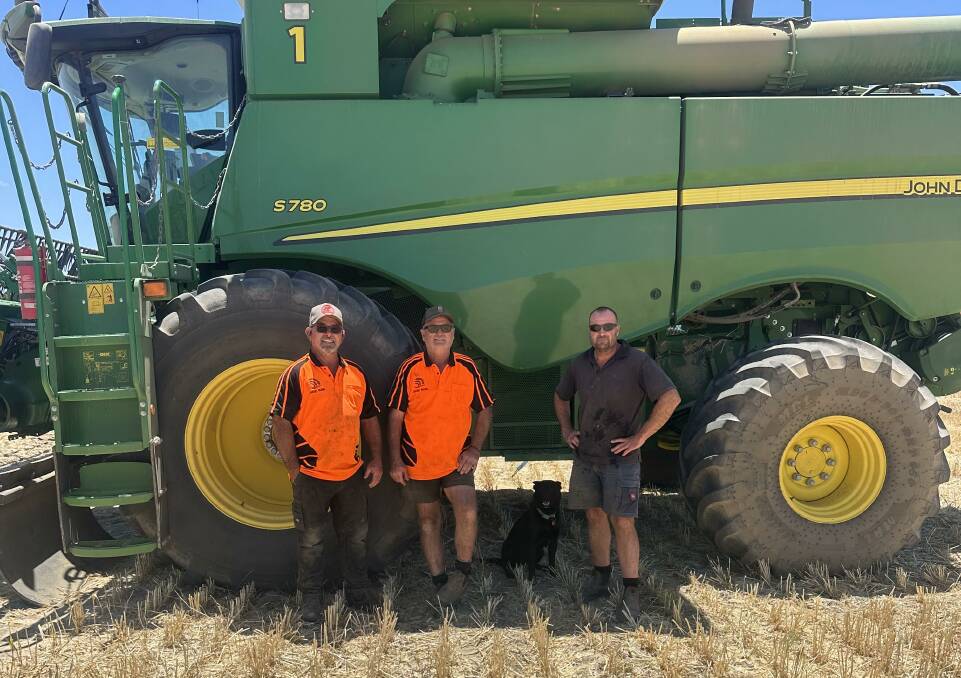
It’s been all hands on deck at the Reid’s property during harvest with Dennis Reid (left) and staff Craig Cox and Richard Daniels on to canola this week. Picture supplied

North Kellerberrin grower Dennis Reid pitched Tomahawk CL against the new RGT Marsh in strip trials this year – and the results were not what he expected.

Both varieties are considered powerhouses for Western Australian broadacre farmers, who now face the challenge of choosing from more than 50 wheat options, with new releases each season.

Tomahawk CL has proven to be the highest-yielding Clearfield wheat in WA and has a grain size and test weight similar to Scepter.

RGT Marsh is a quick-mid variety in terms of season length/phenology, sitting between Vixen, Scepter and Tomahawk CL and giving it a very flexible fit across WA environments.

Mr Reid seeded Tomahawk CL and RGT Marsh in adjacent strips.

RGT Marsh averaged 3.72 tonnes per hectare, compared with Tomahawk CL at 3.65t/ha.

The hectolitre weight of RGT Marsh was 79.2, compared with Tomahawk CL at 74.6 – indicating fewer small grains – while protein was slightly higher in Tomahawk CL at 9.3, compared with 8.8 in RGT Marsh.

“We were really happy with both varieties, but – along with its good grain performance – the RGT Marsh was also noticeably easier to harvest,” Mr Reid said.

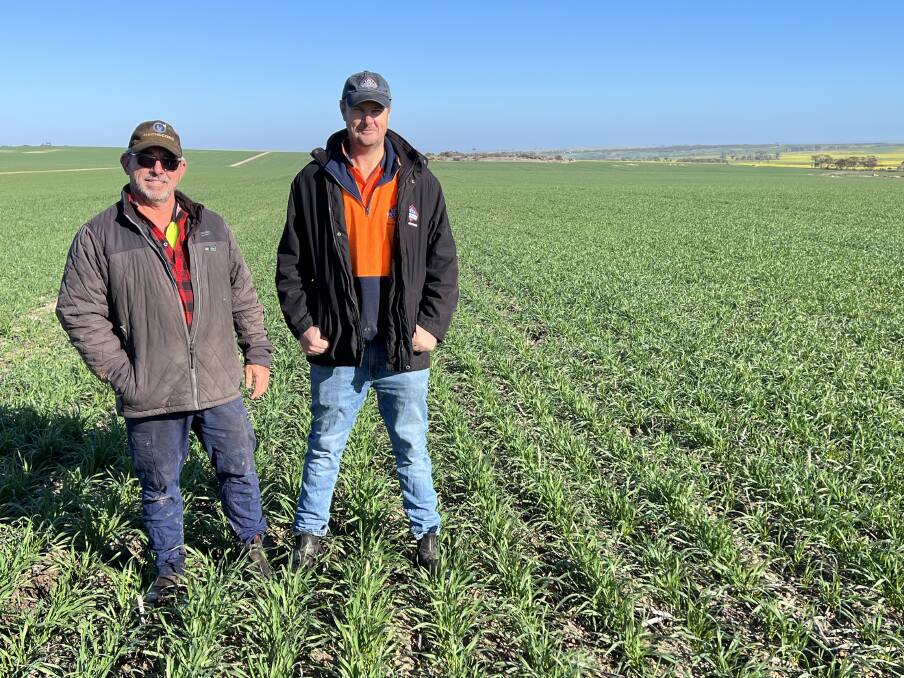
Kellerberrin farmer Dennis Reid (left) and Shane Starling, Eastern Districts Seed Cleaning Co, in Mr Reid’s 110-hectare paddock of new RGT Marsh at the start of this year.

Mr Reid farms with his wife, Sonia, and is using a John Deere 680 and John Deere 780 harvester, both fitted with Harrington Seed Destructors.

This year, the Reids seeded 2200 hectares of their 4000ha property to wheat.

They used Tomahawk CL, Catapult, Calibre and RGT Marsh across 110ha to bulk up seed for next season.

Their canola program covers 1100ha planted to Regiment XC and Hunter TF, and barley comprises 270ha of Maximus.

Smaller areas of lupins and oats round out the program.

Aside from the wheat trial, Mr Reid said they had already harvested 465ha of canola, achieving above-average yields of about 2.4t/ha with excellent oil content.

Like many farmers, he described the season as one “ridden by the seat of your pants”.

“We got early March and April rain, but none in May, only 29 millimetres in June, 36mm in July and then a saving grace of 106mm in August,” he said.

“That August rain changed the game – and another 27mm in September really finished things off nicely.”

Choosing wheat varieties each year remains a difficult decision for the Reids, who require a long-season line, a mid-season line and a specific IMI-tolerant option.

“RGT Marsh might just fit into our system as the main mid-season, non-IMI-tolerant variety,” Mr Reid said.

“It seems to have a good disease package, and it handled this year’s tough conditions really well.

“We’re definitely going to use it as part of the 2026 wheat program, but we’re waiting on its classification before deciding how much to plant.”

RAGT broadacre business development manager, David Peake, said RGT Marsh had been bred specifically for WA Wheatbelt conditions.

He said the late-season rains across much of the agricultural region appeared to have given this new variety an edge in low to mid-rainfall areas, compared with quicker-maturing lines, such as Vixen and LRPB Anvil, which can have capped yields in favourable finishes.

Mr Peake said RGT Marsh had been planted from Mullewa to Beaumont, and, where late rains fell, its performance was particularly strong.

“Feedback from around the State is that RGT Marsh has yielded above the farm average on many properties,” he said.

“With robust performance in tough seasons and standout disease resistance, this variety has proven itself over multiple years where others stumble.

“RGT Marsh is a new yield weapon for WA growers.”

Mr Peake said three years of National Variety Trials across 47 sites showed RGT Marsh to be a consistently strong performer across all WA zones, particularly in May-June sowings.

“Its upright leaves give better light interception, and it has strong resistance to rust, Septoria nodorum and black point,” he said.

“It offers excellent grain quality with low screenings, good grain size and solid sprouting tolerance.

“AH or APW classification is pending from Grains Australia.”

Mr Reid still has 600ha of canola to harvest before moving on to the balance of his wheat crop.

“Our harvest results so far have been amazing, given the season we had,” he said.

“If only grain prices were a bit better.”

RAGT helps harvest rewards at National HYC Awards Roadshow

National HYC awards roadshow kicks off with WA and VIC growers recognised as champions for hyper yielding crops

FAR Australia, Australian based field applied researcher, developer and extension provider is thrilled to announce both the WA and VIC Hyper Yielding Crops Award winners for the 2022 season.

Now in its third year, the GRDC’s Hyper Yielding Crops Awards recognise the efforts and achievements of growers nationally who excel in cultivating high yielding crops, through making effective agronomic decisions according to their location and environment.

Previously the HYC Awards have recognised only high yielding wheat crops, however in 2022, barley was introduced into the awards programme across WA, VIC with and SA.

Taking out two HYC Awards for highest wheat and barley yields in WA was Perillup grower Kieran Allison. Mr Allison’s award-winning DS Bennett wheat crop recorded a 7.98t/ha yield whilst his award-winning RGT Planet barley crop yielded 8.93t/ha.

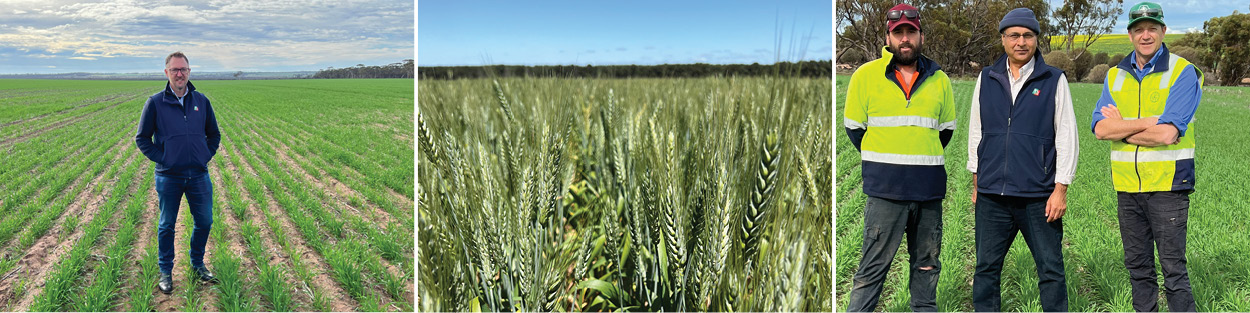
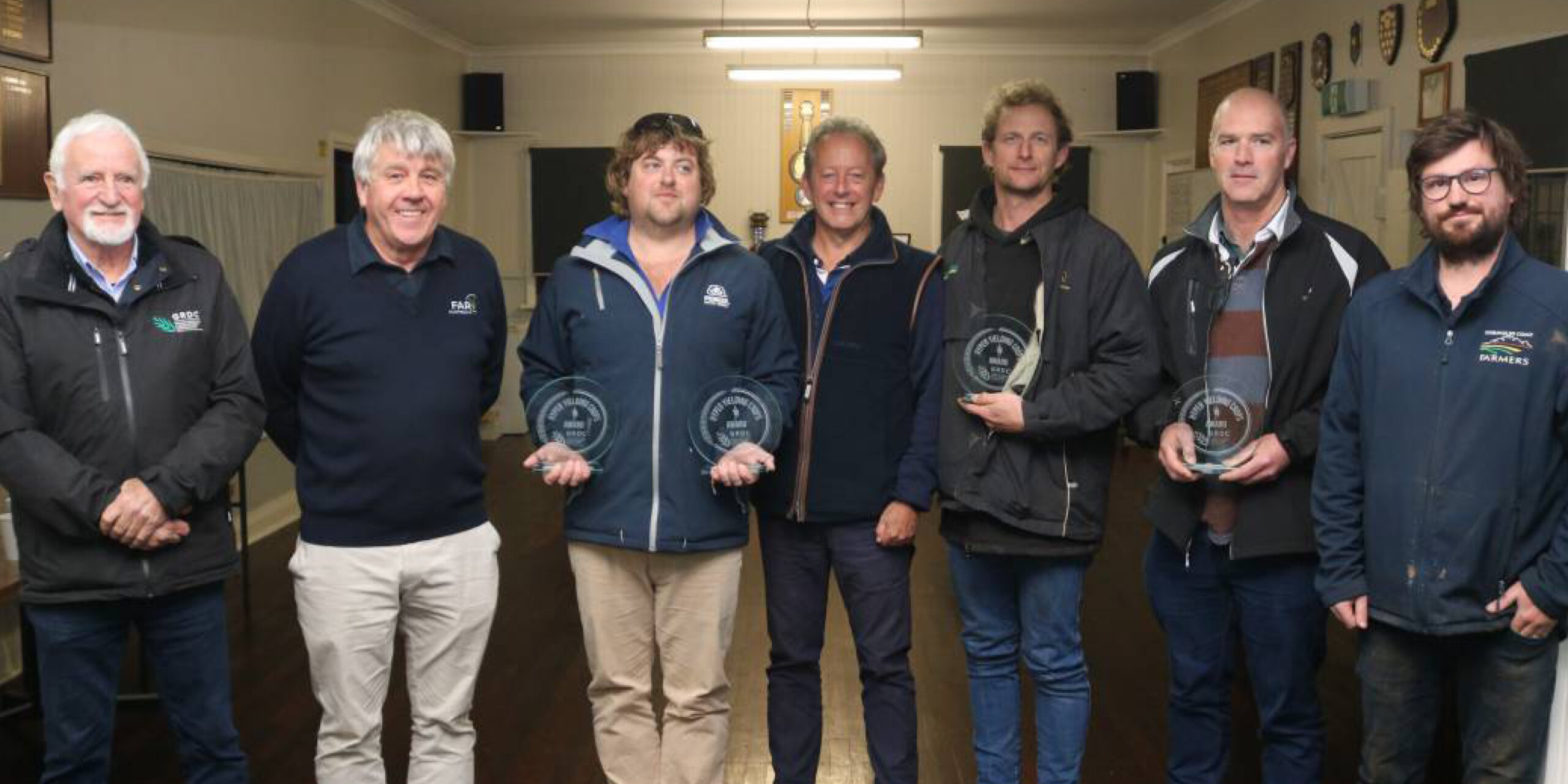
WA winners from left to right – John Blake (GRDC Western Panel member), Nick Poole (FAR Australia), Kieran Allison (HYC Award winner). Jon Midwood (TechCrop), Ben Webb (HYC Award winner), Charles Caldwell (HYC Award winner), Dan Fay (Stirlings to Coast Farmers).

In Victoria, the winning wheat yield clocked 10.59t/ha which was grown by Ascot grower, Ben Findlay. Mr Findlay chose RGT Cesario which was grown over a 42ha paddock. The winning barley yield, RGT Planet was entered into the competition by Streatham grower Ed Weatherly which yielded 7.5t/ha, this was grown over an area of 61ha following wheat.

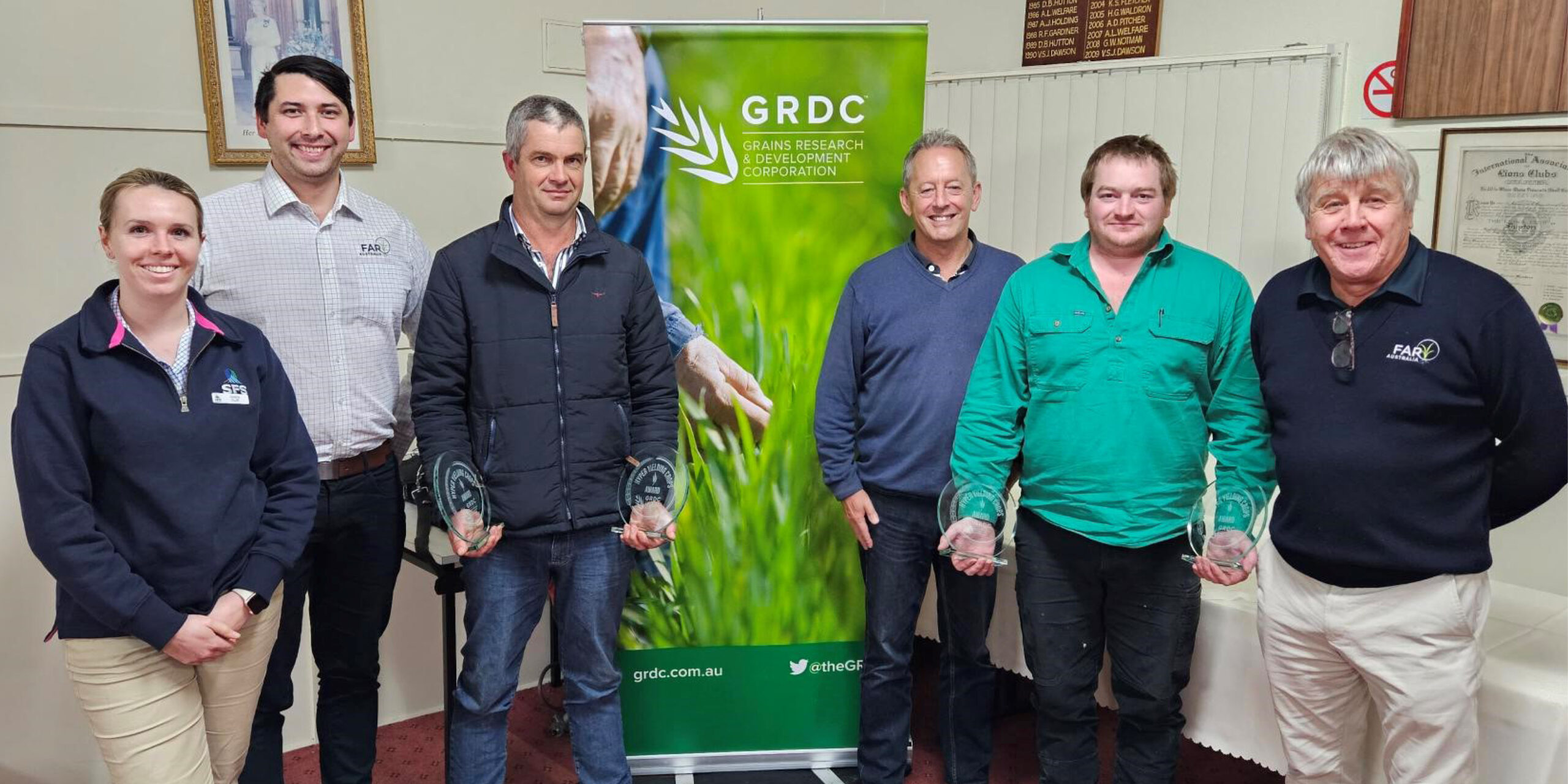
From left to right – Greta Duff (Southern Farming Systems), Darcy Warren (FAR Australia), Ed Weatherly (HYC Award winner), Jon Midwood (TechCrop), Ben Findlay (HYC Award winner), Nick Poole, (FAR Australia).

The HYC Awards also recognise those growers who reach the highest yield based on the percentage of yield potential for their respective regions.

Winning this category in WA for wheat was Scotts Brook grower Ben Webb who topped a yield of 6.54t/ha crop of Planet (79 percent of potential). Charles Caldwell, also from Scotts Brook took out the barley award with his 7.76t/ha crop of RGT Planet (84 percent of potential).

The winning wheat and barley yields in Victoria were also recorded as being the highest percentage of potential with of 87 and 70 percent respectively.

Nick Poole, Managing Director Field Applied Research (FAR) Australia and project lead for the GRDC’s national Hyper Yielding Crops initiative recently presented the 2022 HYC trial results at the WA HYC Results and awards evenings in Kendenup, WA and Skipton, Victoria. Here he jointly presented the HYC Awards with HYC extension co-ordinator Jon Midwood of TechCrop, Dan Fay of Stirlings to Coast Farmers in WA and Greta Duff of Southern Farming Systems in Victoria.

Mr Poole says the HYC Awards have built community interest in pushing productivity boundaries nationally.

“These dedicated growers have demonstrated exceptional agronomic skills and techniques, resulting in remarkable yields whilst contributing positively to the overall success of the Australian grains industry.

“Their innovative approaches and best practices serve as an inspiration to the WA and Victoria cropping communities, driving pursuit of higher crop yields and sustainable farming practices,” he says.

“I would like to extend my congratulations to all winners for their outstanding achievements, these emphasise the importance of a community approach whilst pushing the boundaries to increase productivity and profitability.”

RGT Cesario red winter wheat and RGT Planet malt accredited spring barley

All those who participate in the HYC Awards are presented with a comprehensive report, which not only assists with identifying the different agronomic decisions made throughout the season’s growing conditions, but also provides each grower with the ability to closely benchmark these key decisions with other growers in their region.

Nominations are now open for the 2023 season and growers wishing to participate are urged to contact their respective project officer for more information if they would like to enter a crop this season.

The national HYC Results and Awards roadshow continues throughout July and August in South Australia, Tasmania and New South Wales; further details can be found on the FAR Australia website events page https://faraustralia.com.au/event.

More information https://faraustralia.com.au/hyper-yielding-crops.

WA HYC Project Officer: Dan Fay, Stirlings to Coast Farmers (dan.fay@scfarmers.org.au)

VIC HYC Project Officer: Ashley Amourgis, Southern Farming Systems (aamourgis@sfs.org.au)